

Difference between high-end and budget streetwear
Table of Contents
- What Determines the Difference Between High-End and Budget Streetwear?
- How to Recognize Fabric Quality: What Should You Look For?
- Price Breakdown: What Are You Actually Paying For?
- Why choose independent brands over mass production?
- Sustainability and lifespan: the cost-per-wear calculation
- How can you recognize high-end quality in practice?
- Conclusion
- Frequently Asked Questions
Last updated: September 13, 2026
What Determines the Difference Between High-End and Budget Streetwear?
The difference between high-end and budget streetwear rarely lies in the logo on the chest. It lies in the fabric weight, the finishing of the seams, and whether a garment still holds its shape after twenty washes. At Henk The Tank (HTT), we build our collection around precisely those three factors, because a 380 GSM hoodie simply behaves differently from a 240-gram one.
Most people judge a hoodie by feel in the store. That works, but only if you know where to feel. Below, we explain which signals genuinely indicate quality, how to recognize them, and why a higher price does not automatically mean a better garment.
Fabric Weight and Textile Quality as the First Indicator
Fabric weight, expressed in grams per square meter (GSM), is the quickest sign of quality. A hoodie under 280 GSM feels light and loses its structure more quickly. Heavy fabrics of 350 GSM and above drape better, crease less, and retain their shape after washing.
Still, weight alone is not enough. A heavy fabric made from short, cheap fibers can feel rough and pill quickly. So look beyond the number.
Finishing: Stitching, Seams, and Construction
The inside of a garment tells you more than the outside. Double stitching at the seams, taped shoulder seams, and reinforced ribbed cuffs and waistbands are signs that a brand has not cut corners on construction. Single stitching and loose threads point to fast, cheap production.
How to Recognize Fabric Quality: What Should You Look For?
Recognizing textile quality comes down to four measurable properties: fiber length, yarn count (Ne), weave density, and weight in grams per square meter (GSM). By assessing all four, you can compare two hoodies side by side and make an informed judgment within a minute, without relying on the label.
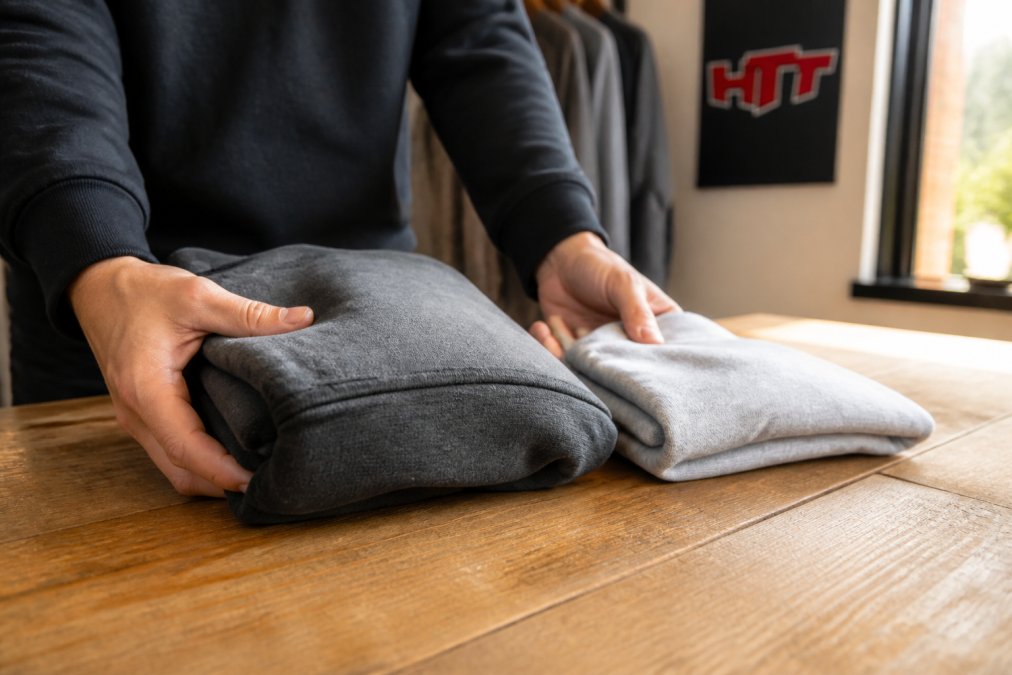
GSM, fiber type, and weave structure
- GSM: under 250 grams is light, 280 to 320 grams is medium, and above 350 grams is heavy and substantial. A 380 GSM hoodie sits more heavily on the shoulders and creases less than a 240-gram one.
- Fiber length: long-staple cotton (typically 28 mm and longer) can be spun into finer yarn without becoming weak. Short fibers break more easily at the surface, which becomes visible as pilling after a few washes.
- Yarn count (Ne): The higher the number, the finer the yarn. A Ne 30 single jersey is thinner and smoother than a Ne 20; fleece and heavy twill use a lower count because the fabric needs to retain volume and warmth.
- Fabric structure: A tightly woven twill or densely knitted fleece retains its shape and warmth better than a loose single jersey. With a loose construction, the threads slide against each other as you move, accelerating wear.
- Fiber blend: A blend with polyester lasts longer and wrinkles less, but breathes less and retains odors longer than 100% cotton. For a hoodie you wear frequently, a high cotton content with a small amount of elastane added to the ribbed cuffs and hem is usually the best balance.
Shrinkage, pilling, and shape retention: the three practical tests
Theory is one thing, but in the store or while trying something on, you can check three things immediately:
- Shrinkage percentage: Most cotton fabrics shrink by 3% to 7% during the first wash unless they are pre-shrunk. Ask for the washing instructions or check the label; if no shrinkage indication is provided, assume the highest percentage.
- Pilling resistance: Rub your thumb firmly over the surface of the fabric. If small fiber balls come loose, the fiber length is short or the yarn is spun too loosely.
- Shape retention: Gently pull the fabric at the hem and release it. Good fabric springs straight back without permanent distortion. If the fabric remains stretched, the fiber structure is weak or the knit is too loose.
Why Fiber Choice Explains the Price
Ring-spun cotton undergoes an extra spinning process in which the fibers are twisted into a finer, more uniform yarn. This takes more time and energy than open-end spinning, but produces a fabric that feels softer, pills less, and withstands repeated washing better. The price difference between a budget and a high-end hoodie is largely due to this step, even before a single seam has been sewn.
Price Breakdown: What Are You Actually Paying For?
A higher price does not automatically mean better quality. Part of what you pay goes toward marketing, distribution, and brand image rather than the product itself. In a budget item, the share allocated to production costs is often lower, while an independent brand that sells directly can invest more of your money in the fabric and finishing.
Production Costs versus Marketing and Brand Image
Large brands pay for campaigns, stores on expensive high streets, and sponsorships. That is reflected in the price. An independent label without that overhead can deliver heavier fabric for the same amount. So look at what you get, not what the name promises.
| Factor | Budget streetwear | High-end streetwear |
|---|---|---|
| Fabric weight | 200-280 GSM | 300-380 GSM |
| Stitching | Single, machine-made | Double, reinforced |
| Fiber type | Open-end cotton, blends | Ring-spun cotton |
| Price structure | A lot of marketing | Higher production costs |
| Lifespan | 1–2 years | 3–5 years |
Why choose independent brands over mass production?
Independent brands have a direct interest in quality because they have to compete on the product rather than on brand recognition. Mass production is driven by volume and low costs per item. That difference is reflected in the choice of fabric, the finishing, and quality control of the final product.
For HTT, this means specifically: our HTT BLANKS Heavyweight Turtleneck Hoodie weighs 380 GSM and features taped seams and a back-spliced construction, something you rarely encounter in budget mass production. Our HTT Essential Unisex T-Shirt uses 100% ring-spun cotton with shoulder-to-shoulder taping, which keeps the neckline sturdy after frequent wear.
Sustainability and lifespan: the cost-per-wear calculation
The cost-per-wear calculation is the fairest way to compare two garments: divide the purchase price by the number of times you actually wear the item. A €37.50 hoodie that you wear one hundred times costs you €0.38 per wear. A cheaper €20 item that loses its shape after twenty washes costs you €1.00 per wear. Sustainability is therefore a calculation, not just a feeling.
The five-year calculation
Most articles stop at the price difference on the day of purchase. More interesting is what happens when you run the same calculation over five years, using a realistic wearing pattern of about twice a week (approximately 100 wears per year).
| Scenario | Purchase price | Wears per year | Lifespan | Cost per wear |
|---|---|---|---|---|
| Budget, replaced after 2 years | €20 | 100 | 2 years | €0,10 |
| Budget, replaced after 2 years (second purchase) | €20 | 100 | 2 years | €0,10 |
| High-end, lasts 5 years | €37,50 | 100 | 5 years | €0,075 |
The crux is not the first purchase, but the replacement cycle. A budget item that you repurchase every two years means five purchases over ten years. A high-end item that lasts five years means two purchases over the same period. The difference in cost per wear only becomes visible when you factor in replacement, and that is exactly what most comparisons leave out.
Care: the factor nobody factors in
The lifespan shown in the table above is not fixed. Care largely determines whether a garment reaches the upper or lower end of that range. The practical rules:
- Wash inside out at a maximum of 30°C. Higher temperatures accelerate shrinkage and damage the fiber structure.
- Use a neutral detergent without bleach. Enzymatic detergents break down protein and cellulose fibers with repeated use.
- Avoid using the dryer on a high setting. Hot air removes moisture too quickly, causing cotton to shrink and the fabric to become stiff. Line drying or flat drying keeps the fibers intact.
- Do not wash it more often than necessary. A hoodie does not need to go in the machine after every wear; airing it out and treating stains specifically significantly extends its lifespan.
- Store it folded, not on a hanger. Hangers stretch the shoulder seams and distort the hood.
The calculator: when is more expensive really cheaper?
Use these three steps to determine whether a more expensive item pays for itself:
- Estimate the number of wears per year. A hoodie you wear twice a week adds up to approximately 100 wears per year.
- Estimate the lifespan in years. A budget item typically lasts 1 to 2 years with intensive use; a high-end item with proper care lasts 3 to 5 years.
- Divide the price by (wears × years). The lowest number wins, regardless of the purchase price.
How can you recognize high-end quality in practice?
You can recognize high-end quality by four things you can check right away: the fabric weight, double stitching at the seams, the sturdiness of the ribbing, and the quality of the print or embroidery. A heavyweight fabric with reinforced seams and a flexible print will last for years.
- Feel the weight: anything heavier than 300 GSM feels immediately different
- Check the seams: double stitching and taped shoulder seams
- Test the ribbing: it should spring back, not stretch out
- Examine the print: flexible prints are less likely to crack than thick, plastic-like prints
- Check the fit: a good cut feels comfortable without being too tight
The difference between high-end and budget clothing comes down to three measurable factors: fabric weight, construction, and fiber quality. Price and brand name say surprisingly little about them.
Conclusion
Choosing a garment that will last for years requires more than looking at the price. You need to feel the fabric, inspect the seams, and calculate the cost per wear. That is exactly why we at HTT specify our fabrics and finishing instead of relying on a logo.
Discover our collection of hoodies, T-shirts, and caps and add your favorite directly to your cart. Every piece complies with EU standards under the General Product Safety Regulation (GPSR).
Frequently Asked Questions
What exactly does high-end mean in streetwear?
High-end refers to clothing that emphasizes fabric quality, construction, and finishing. Think heavier cotton (280–400 GSM), reinforced stitching, and pre-shrunk treatment. It is not just about the price, but about the relationship between what you pay and what you get: better materials and a longer lifespan. A 380 GSM high-end hoodie feels substantial and retains its shape after dozens of washes.
Is a higher price always a guarantee of better quality?
No. A high price tag does not automatically mean better fabrics or construction. Some brands mainly charge for their brand image and marketing. It is better to focus on concrete features: fabric weight in GSM, fiber type (ring-spun cotton versus open-end), double stitching, and whether the garment is pre-shrunk. An independent brand with transparent specifications often offers more quality per euro than a major brand with a well-known name.
How can I recognize fabric quality without touching the garment?
Look at the GSM value: above 280 GSM for hoodies and above 180 GSM for T-shirts indicates sturdy fabric. Check whether ring-spun cotton is used, as it is softer and stronger than open-end cotton. Read the product description for terms such as pre-shrunk, shoulder-to-shoulder taping, and double stitching. A brand that shares these details has nothing to hide about the quality of its fabrics.
Why should I choose an independent brand instead of a well-known brand?
Independent brands often allocate more of their budget to the product itself and less to large-scale marketing. This means better fabrics and construction for the same price. They also often offer unique designs you do not see everywhere. You wear something with its own identity rather than a mass-produced product.