

How is the price of clothing determined? Here’s how it works
Table of contents
- How is the price of clothing determined? The build-up from cost price to consumer price
- Calculating the margin on clothing: from purchase price to selling price
- Recognizing fabric quality: why 180 GSM is priced differently from 400 GSM
- Sustainable clothing pricing: what certifications and fair labor add
- Sustainable clothing pricing: what certifications and fair labor add
- Psychological pricing: why €32,50 feels different from €33
- Price-to-quality ratio and the impact of return costs
- Conclusion: what the price of clothing tells you
- Frequently Asked Questions
Last updated: September 15, 2026
How is the price of clothing determined? The build-up from cost price to consumer price
The price of clothing is determined by a buildup of costs: raw materials, labor, transport, overhead, margin and VAT. This guide breaks down that structure step by step, from the first cotton fiber to the consumer price.
An average garment passes through several stages before it ends up in your wardrobe, and each stage adds its own costs and margin.
The cost price of a garment consists of three main layers: materials, production and logistics. On top of that come overhead, margin and taxes.
The seven cost items that determine every selling price
Every selling price is made up of seven recurring cost items. They apply to every independent label.
- Raw material costs - the fabric itself, plus thread, trims and labels
- Labor costs - cutting, sewing, finishing and quality control
- Transport costs - from factory to distribution center to store
- Overhead - rent, energy, software, salaries of the brand itself
- Marketing and sales - photography, advertising, webshop maintenance
- Margin - the profit markup for wholesalers and retailers
- VAT - 21% on most clothing in the Netherlands
Raw materials and labor together form the basic cost price and determine whether a garment falls into the budget, mid-market or premium segment. Everything after that is markup.
Calculating the margin on clothing: from purchase price to selling price
You calculate the margin on clothing by subtracting the purchase price from the selling price and expressing the difference as a percentage of the selling price. Do not confuse this with markup: markup is calculated from the purchase price, while margin is calculated from the selling price.
The formula:
Margin (%) = ((selling price excluding VAT − purchase price) ÷ selling price excluding VAT) × 100
Markup (%) = ((selling price excluding VAT − purchase price) ÷ purchase price) × 100
A shirt with a purchase price of €10 and a selling price of €25 excluding VAT has a margin of 60% and a markup of 150%.
Worked example: margin, markup and VAT in practice
Suppose: a shirt with a purchase price of €10.
| Item | Amount | Explanation |
|---|---|---|
| Purchase price | €10,00 | What the brand pays |
| Desired markup | 150% | Common in the mid-market segment |
| Selling price excluding VAT | €25,00 | €10 × 2.5 |
| 21% VAT | €5,25 | €25 × 0.21 |
| Consumer price | €30,25 | What the customer pays |
| Margin | 60% | (€25 − €10) ÷ €25 |
The €5.25 VAT is not profit, but money the brand collects for the tax authorities. When comparing clothing prices, you should therefore always look at the price excluding VAT.
Recognizing fabric quality: why 180 GSM is priced differently from 400 GSM
Recognizing fabric quality starts with one figure: GSM, or grams per square meter. A 180 GSM fabric is light and supple; 400 GSM is heavy and sturdy. That difference translates directly into the price, because heavier fabric uses more cotton per garment. A T-shirt requires approximately 1.2 to 1.5 square meters of fabric: at 180 GSM, about 220 to 270 grams of cotton; at 260 GSM, 310 to 390 grams. More than one-third extra raw material.
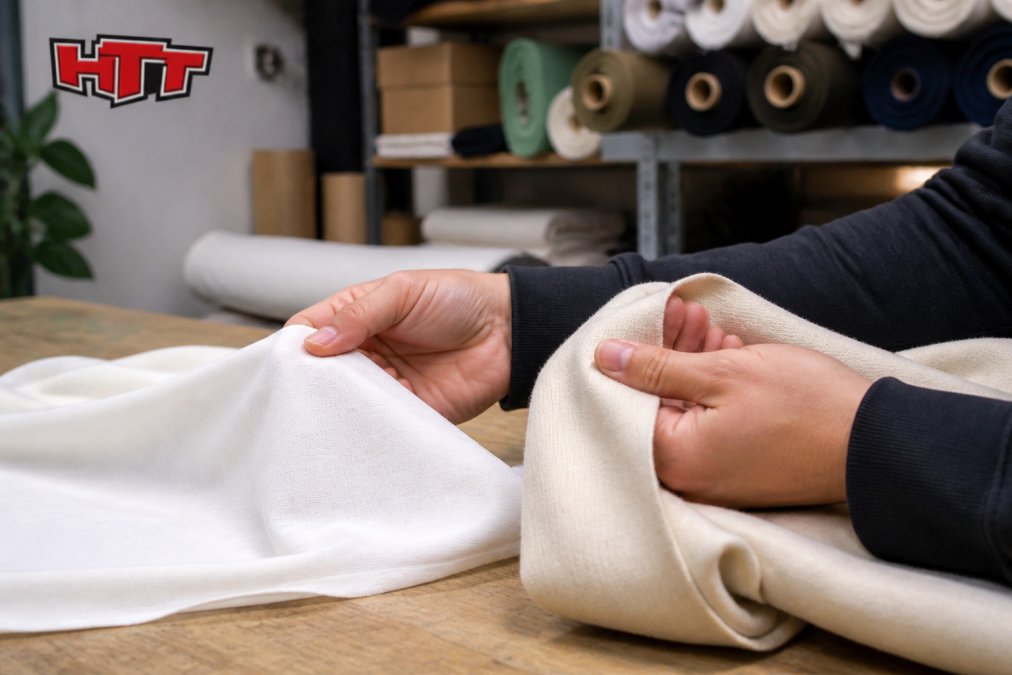
GSM is the quickest measurable criterion, but not the only one. Other signals that justify the price:
- Yarn count and spinning method - combed ring-spun cotton is finer and stronger than carded yarn; it requires more processing time and produces a smoother surface
- Fabric structure - single jersey stretches more than a tightly woven twill; thicker twill uses more yarn per square meter and holds its shape better
- Finishing - a washed finish requires additional production steps (washing, drying, repressing) and gives a softer feel that does not shrink further
- Pre-shrink treatment - prevents a shirt from becoming one size smaller after two washes; an additional production step that increases the cost price by a few percent
- Stitches and seams - a shirt with double-stitched seams at the neckline and sleeves requires more thread and sewing time than a single-stitched one
From fabric weight to price segment: a practical matrix
The table below helps you assess whether a price is justified based on measurable characteristics. The ranges reflect common market patterns, not fixed rules.
HTT Street Attitude Oversized T-Shirt →
| Garment | Common GSM | Feature | Price segment (indicative) |
|---|---|---|---|
| Lightweight T-shirt | 140-180 | Summer, single jersey | Budget to mid-range |
| Heavyweight T-shirt | 200-260 | Year-round, combed cotton | Mid-range |
| Hoodie | 280-380 | Brushed fleece | Mid-range to premium |
| Heavyweight hoodie | 400-450 | Heavyweight, washed | Premium |
| Sweatpants | 300-400 | Brushed, tapered | Mid-range to premium |
A 180 GSM T-shirt is fine for summer days; a 380 to 440 GSM hoodie will keep its shape for years. So when assessing a price, look at three measurable factors: fabric weight, stitch density, and finishing.
Sustainable clothing pricing: what certifications and fair labor add
Sustainable clothing pricing differs from conventional production in two respects: certified raw materials and demonstrably fair labor. Certifications such as GOTS for organic cotton or OEKO-TEX for safe textile chemicals require annual audits, and the certified fabric itself is more expensive than conventional cotton. Fair labor means that a factory pays living wages and records working hours. A GOTS-certified cotton farmer receives a premium on top of the world market price, and the entire chain from spinning mill to garment production must be certified separately. Brands that invest in traceability and ethical production now pass those costs on through the consumer price. This is not a marketing trick, but a real cost that varies by link in the chain: raw materials may be 10 to 30 percent more expensive, while audit and administrative costs per unit decrease as a brand grows.
Why a certification does not automatically justify a higher price
A certificate is a cost, not a guarantee of quality. Two shirts with the same certification can differ by a hundred euros because one brand chooses a small production run while the other opts for mass production. The price-to-quality ratio is therefore determined by the combination of fabric weight, construction, certification, and production volume, not by the logo.
Sustainable clothing pricing: what certifications and fair labor add
Sustainable clothing pricing differs from conventional production in two respects: certified raw materials and demonstrably fair labor. Both cost money, and both are traceable throughout the supply chain.
Certifications such as GOTS for organic cotton or OEKO-TEX for safe textile chemicals require annual audits. Those audits cost time and money, and the certified fabric itself is more expensive than conventional cotton. Fair labor also means that a factory pays living wages and records working hours.
European regulations on textiles will become stricter in the coming years.
Psychological pricing: why €32,50 feels different from €33
Three techniques are most common:
- Charm pricing - prices just below a round number, such as €49,95 instead of €50
- Anchor price - placing an expensive item next to a cheaper one so that the cheaper one seems reasonable
- Bundle price - two items together at a slightly lower price than separately, which increases the average order value
Price-to-quality ratio and the impact of return costs
The price-to-quality ratio is what you get for your money, compared with what a similar product costs.
How return costs mechanically increase the price
Every return costs the retailer money for sending the item back and forth, repackaging it, and sometimes marking down the returned item.
Why this is a blind spot in most price guides
How to assess a price in five steps
European Commission on consumer rights for online purchases
Conclusion: what the price of clothing tells you
A price tag is a summary of choices.
Frequently Asked Questions
What is the average margin on clothing?
This varies significantly by sales channel. In wholesale to retail, the margin is often between 40% and 60% of the retail price, while brands that sell directly to consumers sometimes maintain margins of 60% to 70%. That room is needed for overhead, return costs, inventory management, and markdowns. On a €32.50 shirt, only a few euros in profit often remain after purchasing, VAT, and shipping costs. Always calculate using the net margin, not the markup on the purchase price.
Which factors affect the cost price of a garment?
The main factors are raw materials, labor costs, construction and finishing, transportation costs, overhead, and quality control. Heavier 400 GSM cotton costs more per meter than 180 GSM cotton, and a full-zip with a zipper, lining, and screen print on the back requires more work than a simple shirt. Order size also matters: small production runs reduce the price per item less than runs of thousands of items. All these costs together determine the final retail price.
What is the difference between the purchase price and the retail price?
The purchase price is what a retailer or brand pays the manufacturer or wholesaler for the garment itself. The retail price is what the consumer pays and also includes transportation costs, storage, marketing, customer service, return costs, VAT, and the profit margin. The difference between the two is called the gross margin. For a large proportion of clothing in the lower price segment, this difference is small per item, so retailers mainly have to rely on volume and rapid turnover.
Why are some garments so extremely cheap?
Extremely low prices usually indicate a compromise somewhere: thinner cotton, machine-pressed prints instead of screen printing, minimal quality control, or labor in the lowest-wage segment. Often, these are large production runs in which every step has been optimized, leaving little room for a finish that withstands washing. An €8 shirt may look just as good at first, but after a few washes, the neckline may become misshapen or the print may crack. The price therefore tells you something about what you get in the long term.