

Recognizing quality: a checklist for your purchase
Table of contents
- Why recognizing quality matters
- Recognizing fabric weight: the weight says a lot
- Check stitching and finishing
- Material composition and fiber quality
- Recognizing sustainable clothing brands
- Tactile and visual indicators of quality
- Fit, durability and clothing care
- Your checklist: recognizing quality in practice
- Frequently Asked Questions
Last updated: September 18, 2026
Why recognizing quality matters
Recognizing quality starts with realizing that not all garments are created equal. A twenty-euro hoodie feels different from a fifty-euro hoodie. That difference isn't just in the price; it's in how long the garment lasts and how good it looks after months of wearing and washing.
HTT Streetwear makes garments that truly last. But how can you be sure that what you buy is genuinely good? This guide helps you recognize the signs that reveal quality and the warning signs you should avoid.
The truth is simple: doing proper research before you buy saves you money in the long run. A piece that lasts two years costs you less per month than something that wears out after three months.
Recognizing fabric weight: the weight says a lot
What is fabric weight and why is it important?
Fabric weight is the weight of fabric per square meter, measured in grams (g/m²). This number tells you directly how sturdy and durable a garment will be.
Lighter fabrics feel thin and fragile. Heavier fabrics feel sturdy and have more structure. That weight determines how long your garment will last and how well it retains its shape.
A hoodie with 260 GSM feels different from a hoodie with 380 GSM. You can feel the difference immediately in your hands. The heavier version looks better, feels better, and lasts longer.
Standard values for different garments
Different garments require different weights:
| Garment | Minimum GSM | Ideal GSM | Why |
|---|---|---|---|
| T-shirt | 140 | 180-250 | Lighter, breathable, but still sturdy |
| Hoodie | 300 | 380-450 | Warm, durable, holds its shape well |
| Oversized shirt | 200 | 260-300 | Hangs well, feels premium |
| Sweatpants | 280 | 350+ | Warm, stretchy, not easily worn out |
Check the label. Does it say 150 GSM for a hoodie? Then you know it probably isn't good enough. Does it say 400 GSM? Then you have something sturdy in your hands.
For example, the HTT BLANKS Heavyweight Turtleneck Hoodie has 380 GSM. The HTT BLANKS 440GSM Sun Faded Heavyweight Hoodie goes even further.
Check stitching and finishing
What to check at the seams
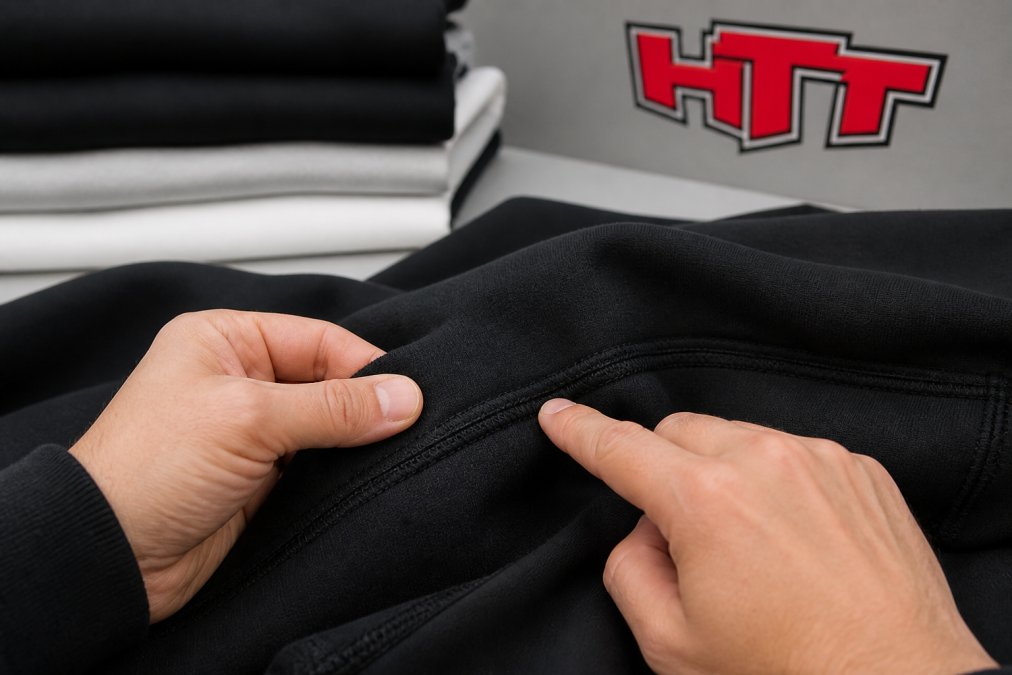
Seams are where garments fall apart or hold together. Poor stitching is the first place problems arise.
Check these things at the seams:
- Double-stitched seams, two rows of stitching instead of one. This is stronger and more durable.
- Even stitch length, the stitches should be the same size, not uneven or irregular.
- Tight tension, the thread should not be loose and should pull properly into the fabric.
- No loose threads, all ends should be finished, not simply cut off.
- Straight lines, the seams run straight, not at an angle or wavy.
Hold the garment. Feel the seams. Are they sturdy? Can you barely feel them because they are so tight? That is good. Do they feel loose or uneven? Then it is probably not well made.
Details that reveal poor workmanship
Some details immediately reveal that something is poorly made:
- Frays, loose threads sticking out of the seams. This happens with poor quality.
- Crooked seams, the seam does not run straight along the edge.
- Holes in the fabric, the needle damaged the fabric instead of passing through it neatly.
- Unfinished edges, the inside looks messy, with threads sticking out.
- Uneven hem, the bottom of the shirt is not straight.
Turn the garment inside out. That is where you can see how well it is really made. Poor manufacturers pay no attention to the inside. Good manufacturers do.
Material composition and fiber quality
Combed cotton versus standard cotton
Not all cotton is the same. Combed cotton is cotton that is combed before being made into yarn. This process removes short fibers and leaves only the long, strong fibers.
The result?
Organic cotton and sustainable alternatives
Organic cotton is cotton grown without synthetic pesticides or fertilizers. It is better for the environment and often better for your skin too.
Other sustainable materials include:
- Ring-spun cotton, yarn twisted in a specific way, making it stronger and softer
- Tencel, made from wood pulp, soft and breathable
- Linen, a natural fiber that is cool and strong
- Recycled polyester, plastic that has been reused
Labels to look for:
- GOTS (Global Organic Textile Standard), organic cotton that is properly certified
- Fair Wear Foundation, factories with fair working conditions
- Oeko-Tex, no harmful substances in the textile
Recognizing sustainable clothing brands
Labels and certifications that matter
Not all labels mean something. Some are just nice words on a sticker. Others are genuinely important.
These certifications are genuine:
HTT Street Attitude Oversized T-Shirt →
- GOTS, organic cotton with checks on working conditions
- Fair Wear Foundation, factories with fair wages and safe working conditions
- Oeko-Tex, no toxic substances in the textile
- EU Ecolabel, a product that meets strict environmental requirements
- GPSR, General Product Safety Regulation, meaning that the product is safe
Transparency in production and origin
Good brands tell you where their clothes are made. They don't hide it.
Questions you can ask:
- Where is this made?
- Who makes it?
- How long do the people there work?
- How much do they earn?
- How does the brand handle waste?
Tactile and visual indicators of quality
What quality feels like
You can feel quality immediately when you touch it. Your hands know what is good.
Checking prints and graphic finishing
Prints can quickly become damaged. Poor-quality prints crack after a few washes. Good prints remain intact.
Check prints for these things:
- Flatness, does the print lie smoothly on the fabric, or does it bulge?
- Color depth, is the color deep and intense, or pale and superficial?
- Edges, are the edges sharp and neat, or fluid and blurry?
- Texture, does the print feel smooth, or does it feel rough and thick?
- Adhesion, is the print firmly attached, or is it coming loose?
Fit, durability and clothing care
How fit determines lifespan
Fit determines how long your clothes last. Clothes that fit well last longer. Clothes that are too tight tear more quickly.
Check the fit:
- Can you move your arms freely?
- Isn't it tight around your chest?
- Does it feel comfortable after an hour of wearing?
- Does it move with your body, or pull?
Care instructions as an indicator of quality
How you wash your clothes determines how long they last. But the label also tells you something about the quality.
Read the label:
- What is the maximum temperature?
- Can it go in the washing machine, or does it need to be hand-washed?
- Does it need to be hung to dry?
- Can it go in the dryer?
Your checklist: recognizing quality in practice
Here is what you should check before buying something:
Material:
- Is the material listed on the label?
- Is it combed cotton or organic cotton?
- Is the weight high enough for this garment?
- Does the fabric feel heavy and sturdy?
Seams:
- Are the seams double-stitched?
- Are the stitches uniform in size?
- Are there any loose threads?
- Are the seams straight?
Finishing:
- Does the inside look neat?
- Are all the edges finished?
- Are there any holes in the fabric?
- Are the sleeves straight?
Prints:
- Do the prints lie smoothly on the fabric?
- Are the edges sharp?
- Do the prints feel smooth?
- Are the prints firmly attached?
Fit:
- Is it comfortable?
- Can you move freely?
- Does it feel too tight anywhere?
- Does it feel like something you would enjoy wearing?
Care:
- What does the label say about washing?
- Can it go in the washing machine?
- What is the maximum temperature?
- Can it be hung to dry?
Frequently Asked Questions
What does 260 GSM or 380 GSM mean in clothing?
GSM stands for grams per square meter and measures how heavy the fabric is. A 380 GSM hoodie feels sturdier and more luxurious than one of 260 GSM. Heavier fabrics generally last longer and retain their shape better after washing. For T-shirts, 260 GSM is on the heavy side; for hoodies, 380 GSM or higher is the standard for quality.
How do I check whether the stitching is properly finished?
Look at three things: are the seams straight and evenly spaced, are there no loose threads, and are there no holes or tears? Double-stitched seams (two rows of stitches) indicate better quality than single seams. Also check the inside: a neat finish there shows craftsmanship. Hoodies should have reinforced necklines and shoulders with tape.
What is the difference between regular and combed cotton?
Combed cotton is filtered to remove short fibers, making it softer, stronger, and less prone to pilling. It lasts longer than standard cotton. If the label says "combed cotton," you are paying for better durability. This is especially important for items you wear and wash frequently.
How do I know if a brand is sustainable?
Look for certifications such as GOTS (organic cotton), Fair Wear Foundation, or OEKO-TEX. Check whether the brand shares information about where and how its clothing is made. A brand that communicates transparently about production and material choices usually also chooses better quality. Avoid brands that only emphasize prices without saying anything about production.