

Buy Secondhand Streetwear Online: Complete Guide 2026
Table of contents
- Why buying second-hand streetwear online is becoming increasingly popular
- Second-hand clothing platforms online: where to find quality
- Checking second-hand clothing sizes: how to avoid bad purchases
- Authentication: how to identify genuine secondhand streetwear
- Price comparison and market value: what is an item really worth?
- Vintage clothing care: how to keep your purchase looking good for longer
- Sustainability and the impact of pre-loved fashion per garment
- Safe payment and returns policy for second-hand purchases
- Frequently Asked Questions
Last updated: September 12, 2026
Why buying second-hand streetwear online is becoming increasingly popular
Buying second-hand clothing online means intentionally purchasing worn or deadstock clothing through digital platforms, from general marketplaces to specialized online stores. It is growing because unique items, lower prices, and sustainability come together in a single purchase. At Henk The Tank, we see this shift reflected in how buyers view clothing: not as a disposable product, but as something of value.
The circular economy has made pre-loved fashion a serious alternative. Where second-hand shopping used to be a last resort, it is now a conscious choice for those who want authentic pieces without paying the full retail price.
Below, we explain how to recognize quality, check sizes, spot counterfeits, and pay safely. The approach we describe comes from the real-world experience of buyers and sellers who deal with these questions every day.
Second-hand clothing platforms online: where to find quality
The quality of a platform determines how great your risk is. General marketplaces offer reach, while specialized online stores offer control.
Marketplaces versus specialized online stores
Marketplaces are large and diverse, but quality control is up to you. Specialized online stores often do the selection themselves, reducing the chance of bad purchases. The difference lies in who is responsible if something goes wrong.
What to look for when choosing a platform
Look for clear return policies, seller verification, and transparent clothing condition. A platform that promises free shipping but has no return policy is a risk.
| Platform type | Advantage | Disadvantage | Best for |
|---|---|---|---|
| General marketplace | Wide selection | Variable quality | Looking for bargains |
| Specialized online store | Selection and quality control | Smaller selection | Authentic items |
| Community selling | Seller knowledge | Limited protection | Brand-specific buyers |
Checking second-hand clothing sizes: how to avoid bad purchases
Sizing is the biggest source of disappointment when shopping online. Sizes have changed over the years, and a size M from 1995 fits differently than a size M from 2026.
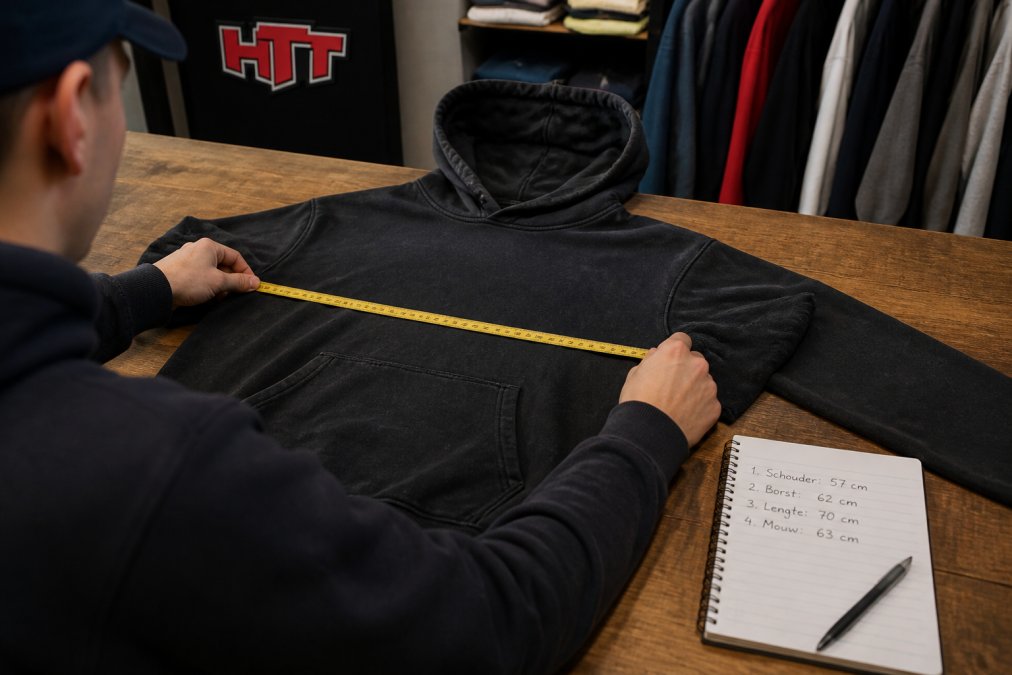
Understanding sizing: old versus new measurements
Vintage clothing often runs smaller than modern sizes because fits and production standards have changed. Always ask for flat measurements: armpit to armpit and length from collar to hem. Those figures say more than the label.
Questions you should always ask the seller
- What is the flat armpit-to-armpit measurement in centimeters?
- Has the item shrunk after washing?
- Are there stains, holes, or signs of wear?
- Is the label still intact and readable?
Authentication: how to identify genuine secondhand streetwear
Authentication is the process of checking whether an item is genuinely from the brand and not a counterfeit. This is essential with secondhand clothing, because the market for fake products is large and most guides stop at saying that you should check the label. Below is a checklist you can go through for each item, with the details that make the difference.
The four authentication checks almost no one mentions
1. Production code and care label. Read the code on the care label aloud and compare it with the number sequences used by the brand itself. Genuine brands use a consistent structure: year, factory, batch. A code that is not logically structured, or a care label whose language does not match the stated production location, is an initial warning sign. Also pay attention to the font: counterfeits often use a slightly different typeface or a logo that is a fraction too large.
2. Stitching and seams. Turn the item inside out. Genuine items have even stitching, tight seams, and finished edges without loose threads. On counterfeits, you will often see a double seam where the original has a single one, or a zigzag stitch in the wrong place. Run your finger along the inside of the collar: genuine finishing is smooth, while counterfeit finishing feels bumpy.
3. Zippers, buttons, and hardware. Zippers on genuine items often have a brand marking on the pull tab or slider. Check whether the hardware matches the production year: a zipper that has only recently been used on an item supposedly from the 1990s doesn't add up. Logo buttons should be sharp and centered; on counterfeits, the logo is often blurry or slightly off-center.
4. Size label versus flat measurement. A common pattern with counterfeit items is that the size label does not match the actual measurements. Measure the armpit-to-armpit width and compare it with the brand's size chart for that year. If it differs by more than two centimeters, further investigation is needed.
A practical order for your purchase
- Always ask for a photo of the care label, size label, and inside of the collar before you pay.
- Compare the production code with publicly available reference materials from the brand itself.
- Look for photos of the same model in the same color and compare the placement of the logo.
- Still in doubt? Ask for an additional photo in daylight, not artificial light.
What you cannot check remotely
Some details can only be assessed in person: the weight of the fabric, the smell of old textiles, and the way a print feels to the touch. If in doubt, ask whether you may return the item based on its authenticity. A platform with a clear return policy gives you the opportunity to check afterward what you could not see beforehand.
Price comparison and market value: what is an item really worth?
The market value of secondhand clothing depends on rarity, condition, and demand. An item that was worth little a few years ago may now sell for twice as much. This is one of the aspects most guides overlook: they only say that you should compare prices, not how to determine the value yourself.
The three factors that determine value
Rarity. An item made in limited quantities or no longer in production is worth more than an item still available in stores. Check whether the model is still being produced. If not, its value generally increases.
Condition. An item with original tags and no signs of wear is worth more than an item with stains or holes. Note: minor repairs can reduce the value, but a professional repair using original fabric can preserve it.
Demand. Some models are temporarily popular and then decline in value. Others are timeless. Look at demand over the past few months, not just today's demand.
How to determine the true market value
The asking price is a wish; the sale price is the truth. Always look for recently sold items from the same brand and model to determine the true market value. Use this order:
- Look for the same model in the same size and color.
- Filter for items sold in the past three months.
- Note the lowest, highest, and average selling prices.
- Subtract the average price from the asking price to see whether there is room to negotiate.
A simple calculation
Suppose you see an item with an asking price of 60 euros. You find three comparable items that sold in recent months for 35, 40, and 45 euros. The average is 40 euros. The asking price is then 50 percent above the market value. That does not automatically mean the item is overpriced, but it gives you room to negotiate.
Why this matters for second-hand items
For new products, the store determines the price. For second-hand items, the market determines the price, and that market differs by model and size. An item in size S may be worth more than the same item in size L, simply because there is greater demand for it. By knowing the market value, you avoid overpaying and can recognize a bargain when you see one.
Vintage clothing care: how to keep your purchase looking good for longer
Vintage clothing care starts with washing at a low temperature and turning garments inside out. Heat and friction are the biggest enemies of prints and stitching.
Wash dark items separately, do not use bleach, and dry flat instead of using the tumble dryer. For delicate prints, hand washing is the safest option. This keeps your purchase in good condition for years.
- Wash at a maximum of 30 degrees
- Wash inside out
- No tumble dryer, dry flat
- Do not iron prints
Sustainability and the impact of pre-loved fashion per garment
Every second-hand garment you buy replaces a new item. This reduces demand for new production and the associated fashion footprint. The impact varies by garment: a heavy hoodie saves more than a T-shirt.
Slow fashion is about buying consciously instead of buying a lot. A second-hand item contributes to the circular economy and keeps garments in use for longer. For those who value sustainable fashion, this is a direct way to make a difference.
Safe payment and returns policy for second-hand purchases
Safe payment means paying through the platform, never directly to a private bank account. Platforms offer buyer protection that you lose as soon as you pay outside the system.
Check the return policy before buying. Some webshops offer free shipping but no returns; others accept returns within a set period. For consumer purchases in the Netherlands, you have a cooling-off period when buying from professional sellers, but this often does not apply to private sellers. Therefore, always check the terms of the specific platform before checking out.
Frequently Asked Questions
What should you look out for when buying second-hand clothing online?
Always check the condition of the clothing using clear photos of seams, prints, and any stains. Ask for the exact measurements in centimeters, not just the labeled size. Review the return policy before paying. Choose platforms with buyer protection and assess the seller based on previous transactions. If you are unsure about authenticity, you can ask for the care label and original proof of purchase.
How do you determine the right size when buying second-hand clothing?
Ask the seller for flat measurements: chest width, length, and sleeve length in centimeters. Compare them with a garment you already own that fits well. Keep in mind that vintage sizes fit differently from modern sizes; an L from the 1990s may run smaller. Streetwear brands vary in fit from collection to collection, so measuring is more reliable than relying on the label.
What are the environmental benefits of buying second-hand clothing?
Every time you buy a second-hand garment instead of a new one, you save the raw materials, water, and energy required for production. The fashion industry's footprint is significant, and pre-loved fashion extends the lifespan of garments. This supports the circular economy: items remain in circulation instead of being thrown away.
How can you recognize the quality of second-hand clothing in photos?
Pay close attention to clear photos of seams, zippers, and prints. Ask for close-ups of any areas showing signs of wear. A good seller describes defects honestly. Check the fabric's overall condition: pilling, discoloration, or stretched hems are signs of wear. For branded clothing, you can ask for the care label; a well-maintained item retains its shape and color longer.
Buying second-hand streetwear online requires a sharp eye for sizing, authenticity, and terms and conditions. Henk The Tank helps you with modern hoodies, T-shirts, and caps that comply with EU standards under the General Product Safety Regulation (GPSR). Add your favorites to your cart and discover designs that suit your style.