

Sustainable materials in modern streetwear fashion
Table of contents
- What makes a material sustainable in modern streetwear fashion?
- Benefits of organic cotton for everyday streetwear
- Textile certificates explained: GOTS, Oeko-Tex, and EU rules
- Recycled polyester, hemp, and Tencel: alternatives compared
- Care and lifespan: how to keep your sustainable streetwear looking good for longer
- Circular business models and the balance between aesthetics and durability
- Conclusion: making conscious choices about sustainable materials in modern streetwear fashion
- Frequently Asked Questions
Last updated: September 12, 2026
What makes a material sustainable in modern streetwear fashion?
Sustainable materials are fibers and production methods that limit climate impact, water use, and resource depletion throughout the entire life cycle, while preserving wear quality and fit. At HTT Streetwear, we assess a fabric on four points: fiber origin, consumption during production, lifespan, and whether the fabric ultimately returns to the supply chain.
The calculation begins with the fiber. Organic cotton, recycled polyester, and hemp place different burdens on soil and water than conventional cotton. An overview of the European textile strategy shows why the European Commission is focusing on circular textile chains: the sector ranks high among resource-intensive industries.
The role of fast fashion and slow fashion
Fast fashion runs on volume and speed: many collections, short lead times, low prices. Slow fashion reverses that logic and designs clothing that lasts for multiple seasons. The difference is not in the label, but in the production process behind it.
- Fast fashion: short lifespan, low fabric weights, rapid trend cycles, limited repair options.
- Slow fashion: higher fabric weights, timeless designs, repair, and reuse built into the model.
A heavier fabric is not a luxury. A 380 g/m² hoodie retains its shape after dozens of washes, while a thin tee loses its silhouette after one season. That difference determines whether a garment lasts two years or ten.
Benefits of organic cotton for everyday streetwear
Organic cotton is grown without synthetic pesticides and with crop rotation, which maintains soil quality. For everyday streetwear, this means a fiber that feels soft, breathes well, and leaves fewer chemical residues in the product itself.
The benefits of organic cotton are evident in three areas: skin comfort, water use during cultivation, and a lower chemical burden on the soil. Cotton is naturally a breathable textile fiber, making it suitable for layers worn all day.
Combed ring-spun cotton and quality retention
Combed ring-spun cotton is yarn made by combing out short fibers and tightly twisting the remaining long fibers. The result is stronger yarn with less pilling. In practice, this means a combed ring-spun cotton tee retains its shape longer than a shirt made from open-end yarn.
Our HTT Urban Streetwear Box Tee uses exactly this yarn, with a fabric weight of approximately 237 g/m². Heavier cotton stretches less at the neck and keeps the shoulder line straight. That is why a 237 g/m² tee still drapes as it did when purchased after twenty washes, while a 140 g/m² shirt will already have started to sag.
Textile certificates explained: GOTS, Oeko-Tex, and EU rules
Explaining textile certificates boils down to this: each certification label covers a different part of the supply chain, and no single label covers everything. If you do not know that, you pay for a green word instead of a guarantee. The three you encounter most often on clothing labels are GOTS, Oeko-Tex, and European product rules, and they overlap less than the marketing suggests.
| Certification label | What it covers | What it does not cover | Who checks |
|---|---|---|---|
| GOTS | Organic fiber, chemicals, working conditions throughout the supply chain | Fabric weight, fit, durability | Independent certifying bodies, annual audit |
| Oeko-Tex Standard 100 | Harmful substances in the finished product | Fiber origin, working conditions | Testing institutes at each production site |
| EU regulations (GPSR, REACH) | Product safety, chemical limits | Fiber composition itself | National market surveillance authorities in the Union |
The key difference: GOTS looks at how a garment is made, while Oeko-Tex looks at what is in it. A shirt can be Oeko-Tex certified and still be made from conventional cotton. Conversely, a GOTS shirt may have a higher fabric weight, but that says nothing about its fit after twenty washes.
How can you recognize a sustainability certification label on clothing?
A reliable certification label always names three things: the name of the certifying organization, a license number, and a reference to a public register. If it only says "eco", "green", or "100% sustainable cotton" without a number, it is a marketing term. That is the essence of greenwashing: a word that sounds like a certification label but has no verifiable source.
Check in this order:
- Name of the certifying organization, is an institution listed, or only a brand name?
- License number, a series that you can look up online.
- Public register, the organization must have a register in which that number appears.
An explanation of the General Product Safety Regulation also helps to understand which safety requirements apply to consumer products in the Union. Note: these rules concern safety, not sustainability. They are not a substitute for a fiber certificate.
Recycled polyester, hemp, and Tencel: alternatives compared
Recycled polyester, hemp, and Tencel compete with cotton in different areas: one in water consumption, another in strength, and the third in softness. Which fiber wins depends on what you use the garment for.
- Recycled polyester (rPET): made from recycled PET bottles. Strong, quick-drying, and suitable for technical fabrics and outerwear. The drawback: it is still a plastic, and microplastics released during washing remain a concern.
- Hemp: one of the strongest natural textile fibers, requiring little water and improving the soil. It feels stiff at first but softens with every wash. Less suitable for a fluid oversized fit.
- Linen: breathable and cool, with a natural texture. It wrinkles quickly, making it less ideal for a sharp boxy fit.
- Tencel (Lyocell): a wood-based fiber produced in a closed-loop process in which most of the solvent is recovered. It drapes softly and fluidly, but requires more careful care than cotton.
Hemp and linen are stronger than cotton, but stiffer. For an oversized silhouette with a soft drape, combed cotton remains the safest choice. If you want a hoodie that retains its structure, a heavyweight cotton such as the 380 g/m² used in our HTT BLANKS Heavyweight Turtleneck Hoodie is more practical than a lightweight hemp blend.
Care and lifespan: how to keep your sustainable streetwear looking good for longer
Care has a greater impact on a garment's lifespan than the fiber itself. A well-made garment that is washed incorrectly wears out faster than a simpler piece that you treat carefully. The biggest gains don't come from the detergent bottle, but from four habits you can adopt for free.
The four habits that make the difference
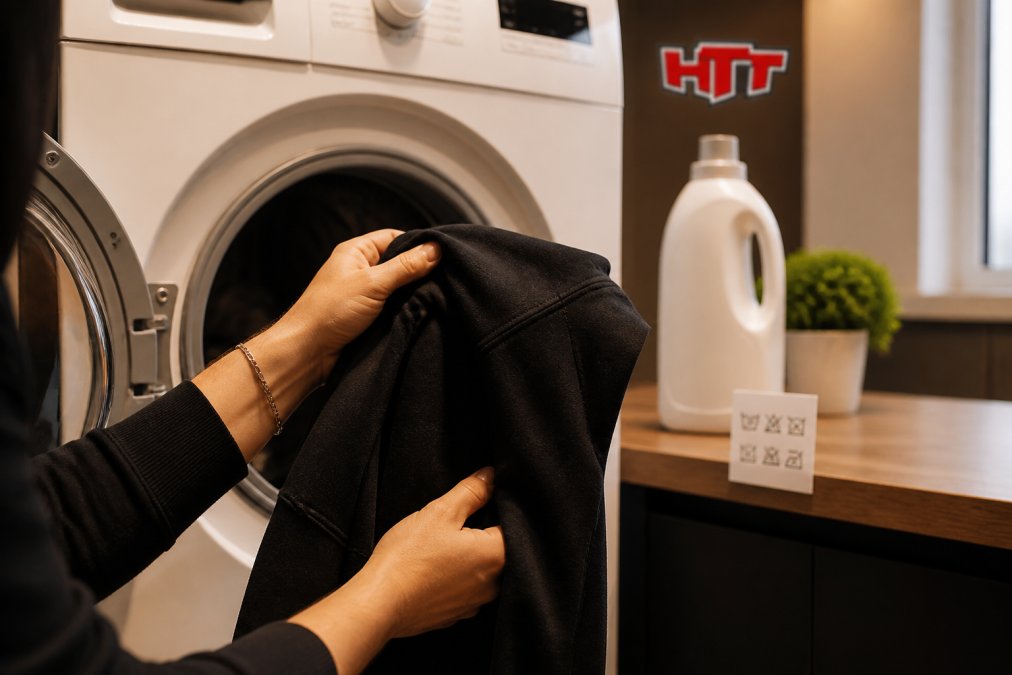
1. Wash inside out at a maximum of 30°C. The outside of a tee or hoodie experiences the most friction in the drum. Washing inside out protects the print and surface fibers. 30°C is the upper limit because most shrinkage and color loss occur above that temperature—not because 30°C itself is ideal, but because washing hotter causes measurably more damage.
2. Use a delicate cycle and a neutral detergent. A delicate cycle spins at a lower speed and uses more water per kilogram of fabric, reducing mechanical stress. Neutral detergent leaves fewer residues in the fibers than an enzyme- or bleach-based formula.
3. Do not soak garments and do not use bleach. Soaking in water causes fibers to swell and weakens the bond between yarns. Bleach breaks down color pigments and damages elastane in ribbed cuffs, precisely the component that helps a hoodie retain its shape.
4. Air-dry away from direct sunlight. A dryer is the biggest source of wear in the entire laundry routine: heat combined with movement shrinks cotton and felts the surface. Air-drying in the shade prevents this. Never iron prints directly; place a cloth between the iron and the print, or iron the garment inside out.
Repair and storage: the forgotten half
Clothing repair and upcycling belong here too. A loose hem or broken zipper is a repair that takes a few minutes, not a reason to throw a garment away. A report by the European Environment Agency on textile waste shows how much usable textile is discarded every year for precisely reasons that can be solved with a needle and thread.
Storage is the other forgotten half. Fold hoodies and T-shirts instead of hanging them on a hanger: a hanger stretches the shoulder line, especially with heavy 380 g/m² cotton. Store knitted or heavy pieces folded in a dry place, away from direct sunlight. This keeps a hoodie’s silhouette intact between seasons.
Circular business models and the balance between aesthetics and durability
Circular business models revolve around clothing returning to the chain after sale: through repair, trade-in, or reuse. For a brand, this means designing for a longer lifespan from the outset, rather than compensating afterward.
The difficulty lies in balancing aesthetics and durability. A heavy, durable fabric drapes differently from a thin trend fabric. Designers therefore have to solve the silhouette and fiber choice at the same time. Our HTT 006 Turtleneck Hoodie shows how this works: 380 g/m² cotton with a high collar and technical seams, a fashion silhouette built on heavy fabric rather than designed around it.
Responsible consumption is the final link. A buyer who wears one hoodie for two years has less impact than someone who replaces four cheap hoodies a year. Maintaining quality is therefore a sustainability strategy, not a detail.
Conclusion: making conscious choices about sustainable materials in modern streetwear fashion
The challenge is not finding a sustainable fabric, but finding a garment in which fiber, fabric weight, and construction come together. Many brands choose a green fiber and cut corners elsewhere.
At HTT Streetwear, we do the opposite: heavyweight combed cotton, fabric weights from 237 to 380 g/m², and finishes such as double stitching and reinforced ribbed cuffs that help retain their shape. Check out the HTT BLANKS Heavyweight Turtleneck Hoodie or the HTT.002 Global Division Snow Wash Oversized T-Shirt and add your size to your cart.
Frequently Asked Questions
What are examples of sustainable materials in modern streetwear fashion?
Organic cotton, recycled polyester (RPET), hemp, linen, and Tencel Lyocell are the most commonly used sustainable textile fibers. Organic cotton uses less water and no synthetic pesticides. Recycled polyester is made from recycled PET bottles. Hemp grows quickly and requires little water. Tencel Lyocell comes from wood pulp using a closed-loop production process. Each material has its own advantages and disadvantages in terms of comfort, care, and climate impact.
How can I recognize sustainable materials on clothing labels?
Check the fiber composition on the care label and look for certifications such as GOTS for organic textiles or OEKO-TEX Standard 100 for chemical safety. A label stating “100% organic cotton” or “recycled polyester” provides clear information about the raw material. Also look for terms such as fair trade or ethical production. Without certification, a claim is difficult to verify. If in doubt, you can request information about a brand’s sustainable supply chain through its website.
Why is organic cotton better for the environment than conventional cotton?
Organic cotton uses significantly less water and is grown without synthetic pesticides or chemical dyes. Its cultivation depletes the soil less and protects farmers from harmful substances. It also makes a difference to the carbon footprint: organic farming emits less CO2 per kilogram of fiber. A GOTS certification guarantees that the cotton was grown organically and processed according to strict environmental and social standards.
How does material choice contribute to a longer clothing lifespan?
Durable fibers such as combed ring-spun cotton and heavyweight fabrics (260–380 g/m²) retain their shape better after frequent washing. They pill less and are less likely to tear. Recycled polyester can be less durable than virgin polyester, so choose a blend with enough cotton. Wash inside out at 30°C, avoid the dryer, and lay flat to dry. Clothing repairs and upcycling further extend the life cycle and reduce your climate impact.