

Why premium cotton makes a difference in streetwear
Table of contents
- What distinguishes premium cotton from standard cotton
- The weight of cotton in grams per square metre (GSM)
- Fit and shape retention: why premium cotton stays in place better
- Comfort and moisture regulation: hygroscopic cotton in practice
- Pilling, abrasion resistance, and the lifespan of your garment
- Sustainable streetwear for everyday wear: organic cotton and environmental impact
- Garment care and washing instructions for premium cotton
- Conclusion: why premium cotton suits your streetwear
- Frequently Asked Questions
Last updated: 22 September 2026
What distinguishes premium cotton from standard cotton
Premium cotton is cotton in which the fibre length, yarn and finishing are selected so that the fabric feels softer, pills less quickly and lasts longer than standard cotton. At HTT Streetwear, it is not about a label, but about what you feel as soon as you put on a shirt.
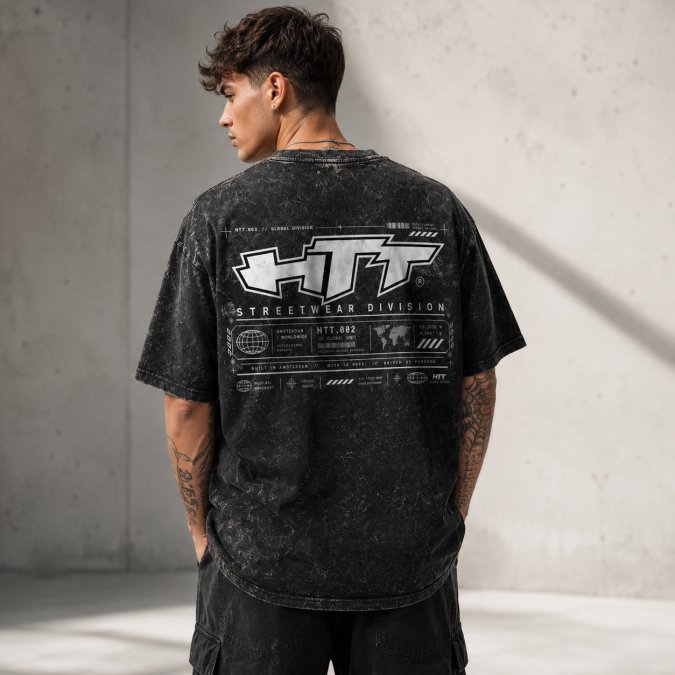
The difference lies in three layers: the raw fibre, the spun yarn and the way the fabric is woven. Standard cotton often uses shorter fibres that do not bond as well during spinning. The result feels fine at first, but loses its shape and structure more quickly.
Premium cotton uses longer fibres, leaving fewer fibre ends on the surface. Fewer protruding fibres mean less friction, less pilling and a smoother surface that retains its texture after multiple washes.
Fibre length and origin: Pima and Egyptian cotton
Fibre length is the most important technical measure in the cotton supply chain. The longer the individual fibre, the more finely the yarn can be spun and the stronger the fabric ultimately is. Pima and Egyptian cotton are known for their longer fibres, resulting in a softer feel and a more even weave.
Origin does not automatically tell you everything. A long fibre that is spun poorly still produces mediocre fabric. The combination of fibre quality, yarn count and weaving technique determines the final result.
The weight of cotton in grams per square metre (GSM)
The weight of cotton in grams per square metre, also known as GSM, determines how substantial a garment feels. A 180 GSM shirt feels lightweight and thin, while 260 GSM to 440 GSM, as used in our collection, produces a full, sturdy fabric that holds its silhouette.

For streetwear, that weight is essential. A heavy fabric drapes differently, holds its shape better, and gives an oversized fit the structure it needs. A thin fabric in an oversized cut quickly collapses and loses its shape.
At HTT Streetwear, you can see that reflected in the collection.
| Garment | Weight | Best for | Fits as |
|---|---|---|---|
| Lightweight T-shirt | 180-200 GSM | Summer, layering | Slim, flexible |
| Heavyweight T-shirt | 260-280 GSM | Daily use, worn on its own | Sturdy, boxy |
| Midweight hoodie | 380 GSM | Transitional season, indoors | Full, relaxed |
| Heavyweight hoodie | 440 GSM | Outdoor, cold days | Structural, oversized |
Fit and shape retention: why premium cotton stays in place better
Shape retention is what keeps a garment wearable even after twenty washes. Premium cotton with longer fibers and a pre-shrunk construction retains its dimensions better, while cheap fabric eventually becomes baggy or shrinks instead.
HTT Street Attitude Oversized T-Shirt →
Comfort and moisture regulation: hygroscopic cotton in practice
Cotton is hygroscopic, meaning the fiber absorbs and releases moisture from the air and your skin. This makes cotton comfortable in changing temperatures: it does not feel clammy, and its breathability remains intact even when you have been active for a few hours.
Pilling, abrasion resistance, and the lifespan of your garment
Pilling occurs when short fibers come loose and form small balls on the surface. It is the most visible sign that a garment is made from lower-quality cotton, and it is almost impossible to repair once it starts.
Sustainable streetwear for everyday wear: organic cotton and environmental impact
Sustainable streetwear starts not with a label, but with the fiber and how long you actually wear a garment. Cotton's environmental impact lies mainly in two stages: cultivation and the lifespan of the finished product. Understanding these two also explains why premium cotton and sustainability reinforce each other rather than stand opposed.
Cultivation: water, pesticides, and soil
Conventional cotton cultivation is one of the most water-intensive forms of agriculture worldwide. In addition, conventional cultivation uses a relatively large share of the world's insecticides and herbicides, even though cotton accounts for only a small portion of global agricultural land.
Fiber length as a durability factor
This is the point most articles overlook: fiber length is not only a quality feature, it is also a durability factor. Short fibers break more quickly, come loose more easily, and form pills sooner. A garment made from short fibers looks worn after one season and is replaced more often. Longer fibers, as found in Pima and Egyptian cotton, keep the yarn intact for longer.
The role of GSM in durability
GSM (grams per square meter) plays an underestimated role. A heavy fabric of 260 GSM or more contains more fibers per square meter and is therefore more abrasion-resistant than a thin fabric of 140 GSM. This is especially relevant for streetwear: an oversized fit requires a fabric that holds its shape. A thin fabric in an oversized cut collapses, stretches at the shoulders, and loses its silhouette.
Buy less, choose better
The textile industry is one of the most polluting sectors worldwide, and the greatest gains come not from a new label but from buying less and choosing better. The European Environment Agency regularly publishes figures on the impact of textile production and consumption in Europe. The conclusion is always the same: the use phase and the lifespan of a garment matter more than most consumers think.
Garment care and washing instructions for premium cotton
Garment care largely determines how long premium cotton stays looking good. The basic rule is simple: wash inside out, at a low temperature, with a mild detergent and similar colors. But why these rules work is connected to the fiber structure and the weight of the fabric. Understanding this allows you to assess for yourself what a garment can and cannot withstand.
Why 30 °C makes a difference
Cotton fibers are made up of cellulose chains that shrink at high temperatures and lose their structure. Pre-shrunk fabric has been treated to prevent this shrinkage, but that does not mean the fiber can withstand every temperature. At 60 °C or higher, the fibers contract further, the fabric deforms and the fit you deliberately chose is lost.
HTT Street Attitude Oversized T-Shirt →
Why washing inside out works
On printed garments, the print is on the outside. Direct contact with the drum and other garments wears the design down more quickly. Washing the garment inside out keeps the print intact for longer. With heavy fabrics of 380 GSM or 440 GSM, the weight itself also plays a role: a heavy garment moves more forcefully in the drum and creates more friction on seams and prints.
Detergent and fiber structure
Mild detergents without bleach protect the fiber structure. Bleach damages the cellulose chains, making the fiber weaker and more likely to break. This manifests as pilling, a gray haze and reduced colorfastness. Reactive-dyed cotton retains its color longer than cheaply dyed fabric, but that dye also cannot withstand harsh chemicals.
Drying, ironing and storing
Hang to dry out of direct sunlight. UV radiation breaks down the fiber and causes yellowing, especially in light colors. Iron at a low temperature, maximum 30 °C, and do not iron prints directly.
| Care step | What you do | Why it works |
|---|---|---|
| Washing | 30 °C, delicate cycle, inside out | Prevents shrinkage and print wear |
| Detergent | Mild, without bleach | Protects the cellulose chains |
| Drying | Hang to dry, out of direct sunlight | Prevents yellowing and shrinkage |
| Ironing | Low, maximum 30 °C | Prevents shine and fiber damage |
| Store | Folded, not on a hanger | Retains the shape of the shoulder |
A washed finish and color transfer
A washed finish, such as on the HTT BLANKS Boxy T-Shirt, may release a small amount of color during the first few washes. This is part of the production process and is not a sign of a defect. Wash the garment separately or with similar colors the first few times to prevent the dye from transferring to other items.

Conclusion: why premium cotton suits your streetwear
Premium cotton is not a luxury for show. It is the reason a shirt still fits well after a year, a hoodie retains its shape, and you reach for something in the morning that makes you feel good. At HTT Streetwear, we build our collection around exactly that idea: fabric, fit, and finishing that make a difference without you having to think about it.
Frequently Asked Questions
Is 100% cotton best for streetwear?
For most streetwear, 100% combed cotton is the strongest foundation. It is breathable, soft to the touch, and retains its shape after washing. Quality does depend on fiber length and weight: a 260 to 280 GSM T-shirt and a 380 to 440 GSM hoodie provide a substantial, premium feel. Polyester blends may be cheaper, but they pill more quickly and lose their structure sooner.
What makes cotton premium compared with standard cotton?
Premium cotton uses longer fibers, often Pima or Egyptian cotton, which are spun into finer, stronger yarn. This results in less pilling, a smoother surface, and better shape retention. The weight per square meter also matters: heavier fabric feels fuller and holds its silhouette longer. Quality control and a pre-shrunk construction make the clearest difference in practice.
Does premium cotton streetwear stay looking better after washing?
Yes, provided you care for it properly. Wash inside out at 30 °C on a delicate cycle with a mild detergent, and avoid the dryer. Pre-shrunk cotton shrinks less, and longer fibers are less likely to tangle, which helps limit pilling. This allows a garment to retain its fit, color, and texture over dozens of washes. Air-drying away from direct sunlight keeps the fabric looking its best for longer.
Is premium cotton more durable for daily use?
Premium cotton is more durable because of its longer fibers and denser weave. With daily wear, you notice this especially around the neckline, shoulders, and hems, the areas that show signs of wear first. A heavier garment of 380 GSM or more holds its shape better. Organic cotton also reduces the use of chemicals in cultivation, lowering the textile industry's environmental impact.