

Why soft cotton stays beautiful longer: 7 washing tips
Table of contents
- Why soft cotton stays looking good longer than you think
- Washing cotton without wear: how to do it
- Prevent cotton from shrinking with the right temperature and spin speed
- Why cotton pills (and how to limit it)
- Textile care after washing: drying, folding, and storing
- Water hardness and eco-friendly detergent: the impact on cotton fibers
- Conclusion: keeping clothing in shape starts with the fiber structure
- Frequently Asked Questions
Last updated: September 10, 2026
Why soft cotton stays looking good longer than you think
Soft cotton stays looking good longer when its fiber structure remains intact: long fibers, a gentle wash program, and a low temperature do more for longevity than any detergent. Garments deteriorate mainly because of what happens in the drum, not because of being worn.
Most laundry advice focuses on stains. That is the wrong goal.
A cotton shirt does not lose its softness because it got dirty. It loses it because thousands of washes wear away a little fiber each time. Below, we explain exactly how this works and what you can do about it.
Fiber length and weaving technique determine the foundation
The quality of a cotton garment starts with fiber length. Longer cotton fibers (long staple) produce a smooth, stronger yarn; short fibers break more easily and cause pilling and a rougher surface.
Ring-spun cotton, in which the yarn is combed and spun into a fine, even thread, retains its structure better than open-end yarn. You only notice the difference after dozens of washes: one shirt stays supple, while the other becomes stiff and dull.
Weaving technique also matters. A dense, even weave distributes mechanical friction across more fibers per square centimeter. With thinner fabric, the drum catches individual threads more quickly.
Washing cotton without wear: how to do it
Washing cotton without wear comes down to three settings: temperature, mechanical friction, and the amount of detergent left behind. Adjust those three and you can keep a shirt wearable for years longer.
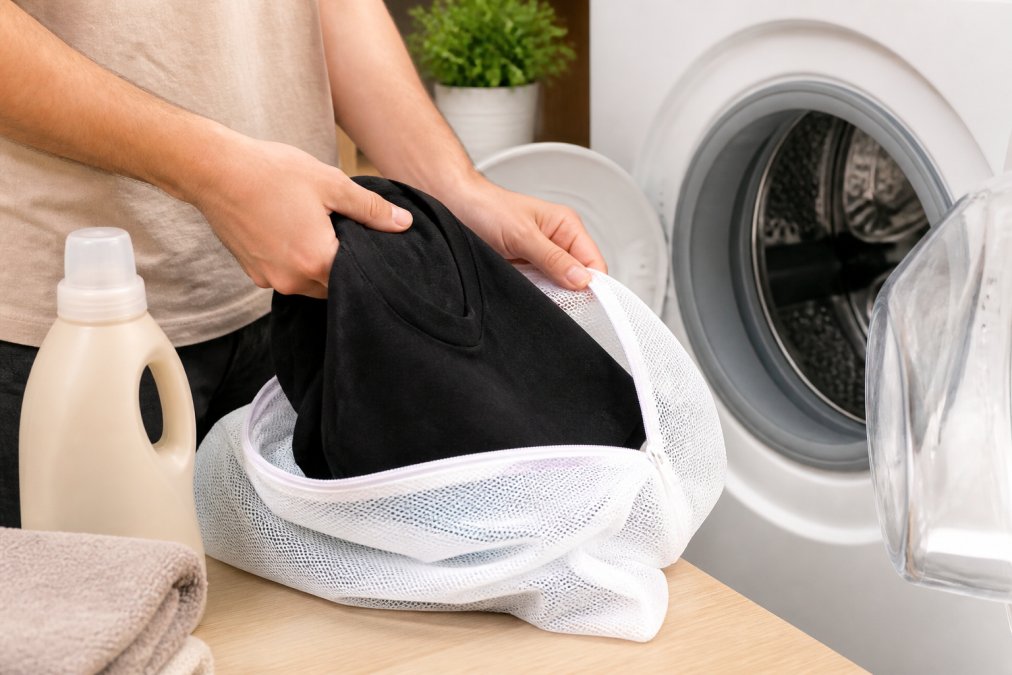
The practical sequence:
- Turn garments inside out before putting them in the drum.
- Put small items and prints in a laundry bag.
- Choose a delicate-wash program with a low temperature.
- Dose the detergent for the smallest load, not the largest.
- Reduce the spin speed.
- Do not wash more often than necessary; air clothes out between washes.
Mechanical friction and detergent residue
Mechanical friction is the greatest source of wear in any drum. During the spin cycle, wet textiles rub against the drum wall and other garments; with a full drum containing heavy items, that strain increases.
Detergent residue works more subtly. If a detergent does not dissolve completely, it remains trapped in the fiber structure. The result is stiffness, a dull appearance, and fabric that holds on to dirt more quickly during the next wash. Eco-friendly detergent without excessive perfume and fillers usually rinses out more cleanly, especially at low temperatures.
Prevent cotton from shrinking with the right temperature and spin speed
Preventing cotton from shrinking is only possible if you understand why cotton shrinks. A cotton fiber is made up of cellulose chains that have a wavy, coiled shape when relaxed. During spinning and weaving, these chains are stretched under tension. When the fiber comes into contact with warm water, the tension relaxes: the chains return to their original shape and the fabric shrinks. The warmer the water and the more aggressive the mechanical process, the more this relaxation is triggered.
That explains why the first wash causes the greatest shrinkage. The fiber expands in warm water and contracts as it cools and dries. Each subsequent warm wash repeats a small part of this process until the fiber reaches its relaxed state.
Temperature: the first setting
- 60 degrees: significant relaxation of the fiber chains, visible shrinkage, and color loss. Only use in cases of contamination risk or stubborn dirt.
- 40 degrees: slight shrinkage during the first few washes, after which the fabric stabilizes. Suitable for heavily soiled cotton items.
- 30-degree delicate wash: minimal relaxation; color and shape are preserved. This is the standard for everyday cotton.
- 20 degrees or cold: even gentler on the fiber, but detergent dissolves less effectively. Use a liquid detergent that rinses out completely even at low temperatures.
Spin cycle: the second setting
During the spin cycle, wet fabric is pressed against the drum wall at high speed. Water is squeezed out of the fiber, but the fiber structure becomes deformed as well. A high spin speed pulls the garment out of shape and leaves the fiber chains stretched. As they dry, they contract further, making the garment shorter and stiffer.
- 1200 rpm or higher: significant distortion, stiffness, and creasing. Avoid for cotton.
- 800 rpm: a reasonable balance between drying time and shape retention.
- 600 rpm: gentlest setting for cotton. The garment stays in shape longer, but dries more slowly.
| Setting | Effect on the fiber | Recommended |
|---|---|---|
| Wash at 60 degrees | Significant relaxation, shrinkage, and color loss | Avoid |
| Wash at 40 degrees | Slight shrinkage during the first few washes | Only for stubborn dirt |
| 30 degrees delicate cycle | Minimal shrinkage, color retention | Standard |
| 20 degrees cold | Very gentle; detergent dissolves less effectively | For fine cotton |
| Spin at 1200 rpm | Deformation, stiffness | Avoid |
| 800 rpm | Balance between drying time and shape | Acceptable |
| 600 rpm | Shape is retained | Standard |
Why the first wash causes the most shrinkage
The first wash is when most of the tension leaves the yarn. Manufacturers sometimes pre-treat cotton with a shrink-resistant treatment, but it is never complete. Expect shrinkage of a few percent during the first cycle at 40 degrees or warmer. Therefore, wash a new cotton garment at 30 degrees on a delicate cycle the first time and air-dry it. This stabilizes the fiber without compromising its shape.
Why cotton pills (and how to limit it)
Why cotton pills has one simple cause: short fibers come loose from the yarn, roll into small balls during washing, and remain on the surface. Lint and pilling are therefore not signs that the fabric is dirty, but that the fiber structure is breaking down.
Three things accelerate this process:
- Washing with items that have hook-and-loop fasteners, zippers, or rough seams
- An overfilled drum, causing garments to rub against one another
- A temperature that is too high, which weakens the fibers
Limit pilling by washing garments inside out, using a laundry bag, and not filling the drum beyond about three-quarters full. A clothing brush or razor removes existing pills, but does not restore the fiber.
Textile care after washing: drying, folding, and storing
Textile care after washing matters at least as much as the washing itself. The drying process is where much cotton ultimately loses its shape.
Air-drying is the gentlest option. The garment hangs, the water evaporates slowly, and the fiber structure remains intact. Do not dry cotton in direct sunlight, as this accelerates color fading.
The dryer is the fast but harsh option. The heat and tumbling cause fiber damage and lint; with every cycle, the fabric loses more fibers. If you do use the dryer, use the lowest setting and remove the garment while it is still slightly damp.
Folding and storing:
- Fold shirts and hoodies flat instead of pulling them over a hanger
- Store knits and heavy cotton flat, not hanging
- Let garments dry completely before putting them in the closet
- Do not use excessive fragrance sachets; they draw moisture and odors into the fiber.
Water hardness and eco-friendly detergent: the impact on cotton fibers
Water hardness is the factor most laundry guides overlook, even though it determines the outcome in large parts of the country. Hard water contains dissolved calcium and magnesium ions. These ions bind to the surfactants in detergent and form insoluble compounds, also known as soap scum. The result: less cleaning power remains, and a fine mineral layer settles on the cotton fiber.
That layer is the problem. Cotton is naturally hygroscopic: the fiber absorbs moisture and releases it again. A mineral deposit on the fiber wall blocks this process. The fiber feels stiff, absorbs less water during washing, and actually retains dirt more readily. Softness is therefore not only a matter of fiber quality, but also of what accumulates on the fiber.
The mechanism in three steps
- Calcium and magnesium in the water bind to the detergent.
- Residue remains on the fiber in the form of soap scum and mineral deposits.
- The fiber becomes stiff and dull and holds on to dirt and odors more readily.
What you can do about it
- Dose detergent based on water hardness, not drum size. Hard water requires a slightly higher dose, but never double: excess detergent does not rinse out completely and worsens the problem.
- Choose an eco-friendly detergent without excessive fillers and fragrance. Fewer fillers mean less residue that can adhere to the fiber.
- Add a splash of vinegar to the rinse cycle. Vinegar partially dissolves mineral deposits and neutralizes detergent residue. Do not use it for every wash, but as a maintenance treatment.
- Consider a water softener or a laundry ball that binds calcium ions before they attach to the detergent. This is especially worthwhile in regions with hard water.
Why hard water systematically undermines softness
Softness depends on how freely the fiber chains can move. A mineral deposit on the fiber wall acts like a layer of sandpaper: the chains can move less freely, the fiber feels rougher, and the cotton loses its fluid drape. In areas with hard water, it is therefore especially important to pay attention not only to temperature and spin speed, but also to the chemistry of the water itself. Doing so keeps cotton noticeably softer for longer.
Conclusion: keeping clothing in shape starts with the fiber structure
Keeping clothing in shape is not about expensive products, but about treating the fiber structure gently. Low temperatures, a delicate cycle, a laundry bag, moderate spinning, and not using too much detergent do more than any product can.
At HTT Streetwear, you will find shirts made from ring-spun cotton, such as the HTT Essential Unisex T-Shirt and the HTT Street Attitude Oversized T-Shirt made from 260 GSM heavyweight cotton. Both are designed to be worn and washed every day. Add one to your cart and keep it looking good for longer.
Frequently Asked Questions
How can I prevent cotton from shrinking?
Wash cotton at a low temperature (no higher than 30 degrees) and avoid a high spin speed. Choose a delicate cycle and air-dry garments on a clothesline instead of using a dryer. By limiting mechanical friction and the drying process, the fiber structure remains intact and your cotton retains its shape better. This helps soft cotton stay looking good for longer, wash after wash.
Why does high-quality cotton pill less quickly?
High-quality cotton has longer fibers, meaning fewer loose fiber ends that can tangle into pills. With short fibers, damaged ends become tangled more easily during washing, resulting in visible pills. A delicate cycle, an eco-friendly detergent without harsh additives, and a laundry bag reduce mechanical friction and keep the fiber structure smoother.
What is the difference between cotton and soft cotton?
Soft cotton is not a separate type of fiber, but cotton processed to feel smoother. This is influenced by factors such as fiber length, weaving technique, and a wash that reduces stiffness. The natural fiber is still simply cotton. By washing it at a low temperature and taking proper care of the textile, soft cotton retains its smoothness and color for longer.
Does fiber length affect the lifespan of cotton?
Yes. Longer cotton fibers create stronger yarn with fewer loose ends, making the material less prone to wear and pilling. Short fibers break down more quickly, leading to pilling, color loss, and a stiffer texture. When choosing garments, it is worth looking for ring-spun cotton or a higher fabric weight, as this often translates into a longer lifespan.